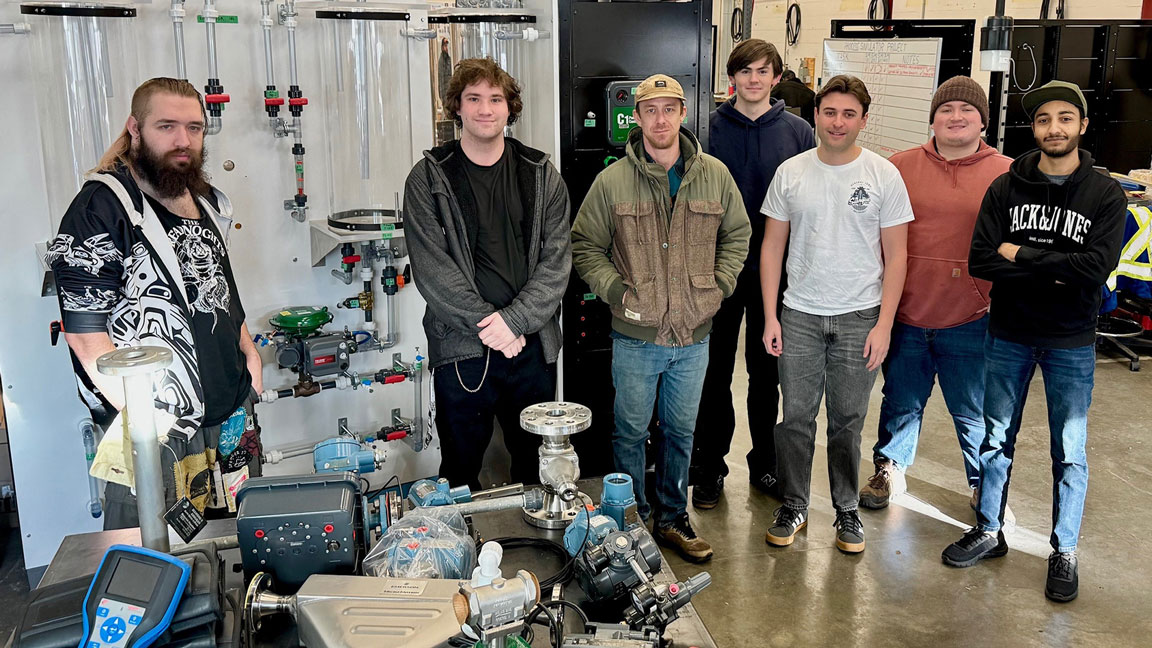
North Island College students will have more tools for learning industrial automation and instrumentation because of the support of an industry leader.
Spartan Controls, a company with more than 60 years in industrial automation throughout Western Canada, is providing equipment that will be integrated into NIC’s Process Measurement, Process Control and Capstone Project courses. The donation is the largest in-kind donation through the North Island College Foundation.
This access to modern instrumentation will give students hands-on experience with industry-relevant technologies in a range of fields, such as industrial automation, manufacturing, utilities and resource industries.
“This donation significantly enhances our ability to deliver applied, real-world training,” said Cory Batch, Instructor, Instrumentation and Electrical Automation, North Island College. “Our students will be working with the same types of instruments and transmitters they will encounter in industry, strengthening their technical skills, confidence, and job readiness.”
Because of Spartan’s efforts, students will be working with approximately 30 pieces of equipment that control and measure pressure, temperature and flow.
“It’s a modular system, with different components, valves and flow regulators, assembled with piping to regulate and control fluid flow and support calculations,” said Chris Manning, acting dean of the Faculty of Trades and Technical Programs.
Glenn Cherepak, Spartan Controls vice-president, Process & Infrastructure, describes the equipment as “key components in support of the industrial processes that power the modern world,” often used in a range of industries from mining, power, pulp and paper to life science and data centres.
The company, he adds, has a history of supporting post-secondary education throughout Western Canada.
“We do believe that education is the building block of a modern society,” Cherepak said.
The arrangement happened, in part, because Manning has an existing relationship with the company from when he was working at the Northern Alberta Institute of Technology. He reached out to his contacts in Edmonton, who then put him in touch with the B.C. office.
“We started having conversations. Cory developed a list of equipment he’d ideally need to complete his project. Glenn and his team took a look at it and were very supportive,” Manning said.
With all the talk about artificial intelligence, Cherepak points out the company has been working with advanced digital technology for many years. The key, he explains, is integrating human know-how with the latest technology.
Overall, Cherepak sees many opportunities ahead for students considering a career in industrial automation.
“In terms of career paths, the future looks bright,” he said.